

Welcome to issue #017 of our Cookbook Chronicles! Each week, I share lessons and wisdom from our cookbook development, preserving my dad’s 50 years of experience as a Chinese chef.
If you want to help shape our efforts in making a timeless Cantonese cookbook, join our community. You’ll get a digital copy once it’s ready, as well as full access to our weekly Cookbook Confidential and our private group chat. Founding Members will also have their name in our cookbook acknowledgements, and a signed physical copy.
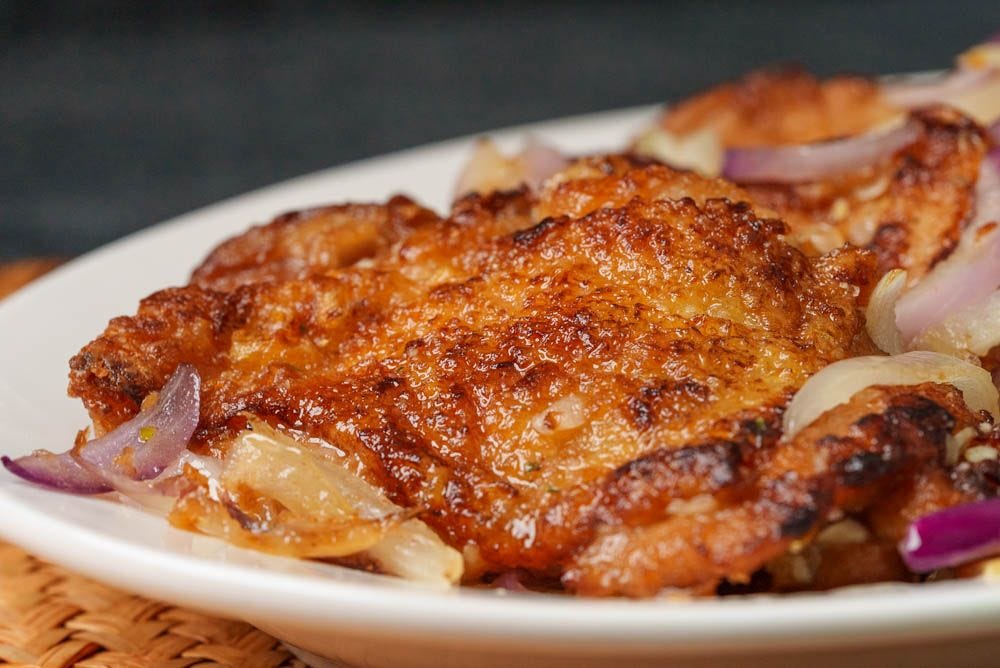
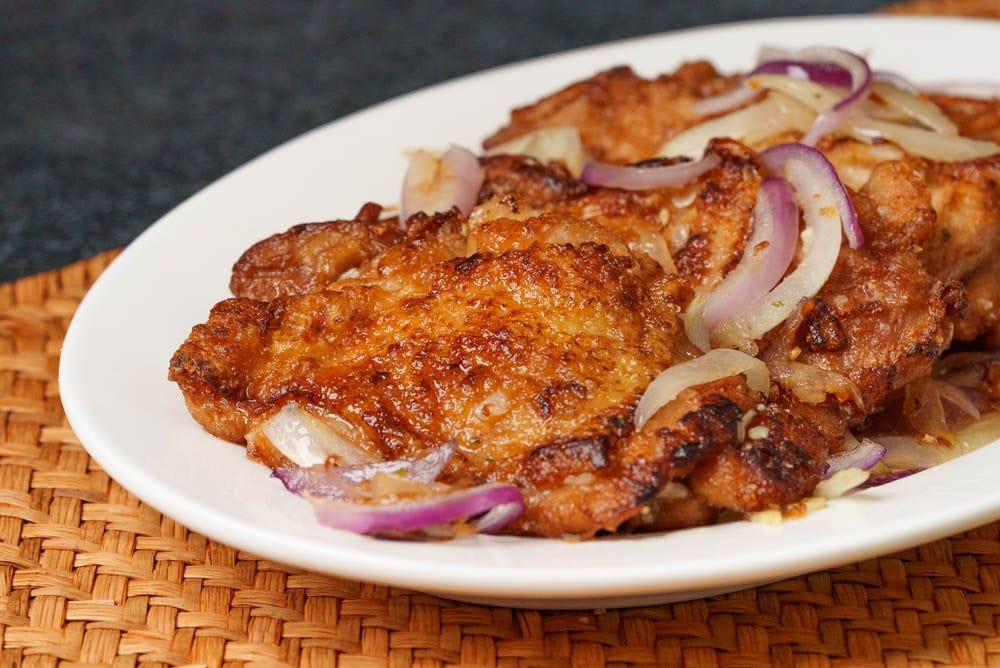
Master the basic yet irresistible pan-fried chicken thigh with our easy-to-follow recipe! It’s a straightforward dish that is enjoyed especially as the main star of the famous Hong Kong diner lunch sets, but fits great in any meal of the day.
This is one of our most-watched recipes for a reason! It’s a simple skillet dish: marinate, pan-fry until golden, then finish with onion, garlic, and a quick steam of cooking wine. If you’ve cooked with us before, the technique will feel familiar. If you haven’t, this is a great place to start.
Prep time and servings
Prep: 25 min
Cook: 15 min
Total: 40 min
Serves: 4
Notes
Can I use chicken breast?
Yes! You can use this recipe for any part of the chicken that you prefer. We recommend chicken thigh because we like how the dark meat is naturally flavorful and succulent. If you prefer to eat chicken breast, follow the recipe exactly as is, but adjust the cooking times so that the chicken does not overcook and dry out. You can even do this with drumsticks or leg quarters; again, all you’d need to adjust is the cooking time.
Two types of onions
If you look at our ingredient list, you’ll notice we use two kinds of onions: half a white onion, and half a red onion. This is purely an aesthetic choice; we like the variety in color. You can add yellow onion to your list of options, too. If you’d prefer to use just one whole onion, that’s totally fine.
From the perspective of Cantonese cuisine, red, white, and yellow onions don’t differ much in terms of taste, and we basically make all of our 洋葱 “Western onion” decisions based on looks.
Is the cooking wine necessary?
The cooking wine in this recipe has a particular function: it makes an instant connection to alcohol-soluble flavor compounds that would otherwise prefer to stay in the background.
As a marinade component, alcohol carries and infuses oil-soluble and water-soluble flavors that don’t naturally want to mix. It also helps to counteract possible gaminess in fish and meat. When added during the cooking process, the alcohol increases the release of aromatic molecules, enhancing the sensory experience of the dish. We apply both techniques in this recipe for maximum impact.
If you omit the cooking wine, the chicken will still taste amazing! You’ll miss out on those effects of using alcohol, but you can use water or any kind of broth in the last steaming step to at least get the effects of the steam-cooking.
Frequently Asked Questions
How do you reduce oil splatter when pan-frying?
Honestly, when you cook anything with moisture using any amount of oil... it’s going to splatter. Here’s how you keep your kitchen clean:
Dry the surface of your ingredients so there’s less surface water to interact with the hot oil
Use a deeper cooking vessel with high walls that can catch more splatter
Wipe down surfaces when it’s safe to do so
Invest in an oil-splatter screen
How do you keep chicken from sticking to the pan?
My dad has pretty universal rules for preventing sticking:
Heat up your pan or wok until it’s completely dry and quite hot
Add the oil and give it a quick swirl to coat
Once the oil is hot, add the cornstarch-coated chicken (and turn down the heat so it doesn’t burn!)
Don’t move the chicken until the bottom surface has seared into a nice, golden-brown crust that naturally releases from the pan or wok
How do you know when the chicken is cooked?
The most foolproof way is to use a thermometer to ensure that the thickest part of the chicken reaches the USDA-recommended internal temperature of 165 ºF. If you don’t have a thermometer, you can pierce the thickest part with a chopstick or a small knife and make sure that the juices run clear, and that the liquid is not bloody. Over time, you’ll cook this enough that you can make a pretty accurate guess based on timing and exterior coloring.
How do you reheat pan-fried chicken thighs?
If you want to preserve the crispiness of the outside, your best bet will be a toaster oven, air-fryer, or conventional oven; timing and temperature settings will differ based on how powerful your devices are!
When we’re in a rush, we’re totally happy with microwaving this. Because we use dark meat and get it as juicy as possible during the marinating and initial cooking process, we find that it stays succulent even after we microwave it the next day!
Ingredients
Main Ingredients
17 oz chicken thigh
½ red onion
½ white onion
3 clove garlic
3 Tbsp cornstarch
2 Tbsp oil
Marinade
1 Tbsp oyster sauce
1 Tbsp soy sauce
1 Tbsp cooking wine (Shaoxing or any other kind of cooking wine)
1 tsp salt
1 tsp sugar
½ tsp white pepper
2 Tbsp cornstarch
½ oz ginger
Miscellaneous
1 Tbsp cooking wine
½ tsp garlic salt
Step 1: Prepare marinade
To prepare the marinade, combine oyster sauce (1 Tbsp), light soy sauce (1 Tbsp), cooking wine (1 Tbsp), salt (1 tsp), sugar (1 tsp), white pepper (½ tsp), and cornstarch (2 Tbsp) in a small bowl.
Mince the ginger (½ oz) and add it to the bowl. Stir to combine.
Step 2: Cut aromatics
Cut the white onion and the red onion into slices; the thickness is up to how crunchy you like your onions. Slice them more thinly if you want them to melt into the dish, or cut thicker slices if you prefer crisp bites of onion.
Mince the garlic (3 clove).
Step 3: Debone & trim chicken
It’s optional to debone the chicken (17 oz), and to trim the skin and excess fat; we like to do both for a better eating experience. To remove the bone, angle your knife towards it and slice down both sides. When the bone is more exposed, pull it up vertically and slice around it to release it from the flesh.
Slice through the thicker parts of the flesh for even cooking. If you don’t, the thinner parts of the chicken will finish cooking before the thicker parts do.
Step 4: Marinate chicken
Dry each piece of chicken with a clean towel or paper towel, then place them into the bowl of marinade. Coat each piece thoroughly, then set aside for about 10 minutes. For maximum penetration of the flavor into the chicken, keep the meat-side down facing the marinade (as opposed to the skin side which wouldn’t absorb the marinade as well).
When they’ve finished marinating to your satisfaction, spread an even layer of cornstarch (3 Tbsp) on a plate, and coat each side of the thighs with a thin layer of cornstarch. Gently shake off excess cornstarch.
Step 5: Pan-fry chicken
Heat a skillet or flat-bottomed wok on high heat. Once it’s hot, add oil (2 Tbsp).
When the oil’s shimmering, turn the heat to medium-low, and place each piece of the chicken skin-side down. Cook until golden brown, or about 2-3 minutes.
Flip the chicken over and cook the other side until it’s also golden brown, or about 5-6 minutes.
When both sides are beautifully golden brown, flip all the pieces back to the skin side and cook for another 1-2 minutes to make it crispy.
Step 6: Add aromatics & final seasoning
Make some room by pushing the chicken to the sides of the pan. Add the minced garlic to the now-vacated middle of the pan, and cook until fragrant, or 10 seconds.
Add the sliced onion and spread it out in the pan as you cook until that’s also fragrant, or 20 seconds.
Pour cooking wine (1 Tbsp) into the pan and immediately cover with the lid. This allows the steam to cook everything further while melding all the aromas and flavors together.
Turn the heat to high to reduce the sauce down. Cook covered like this for just 30-40 seconds.
Uncover the pan and sprinkle garlic salt (½ tsp) over the chicken for a final touch of seasoning. Give everything a quick mix to distribute. Plate your creation by creating a bed of onions on the bottom, perching the chicken thighs on top, and decorating with the most beautiful pieces of onion on top. Enjoy!
With love,
Randy & the Lau family


